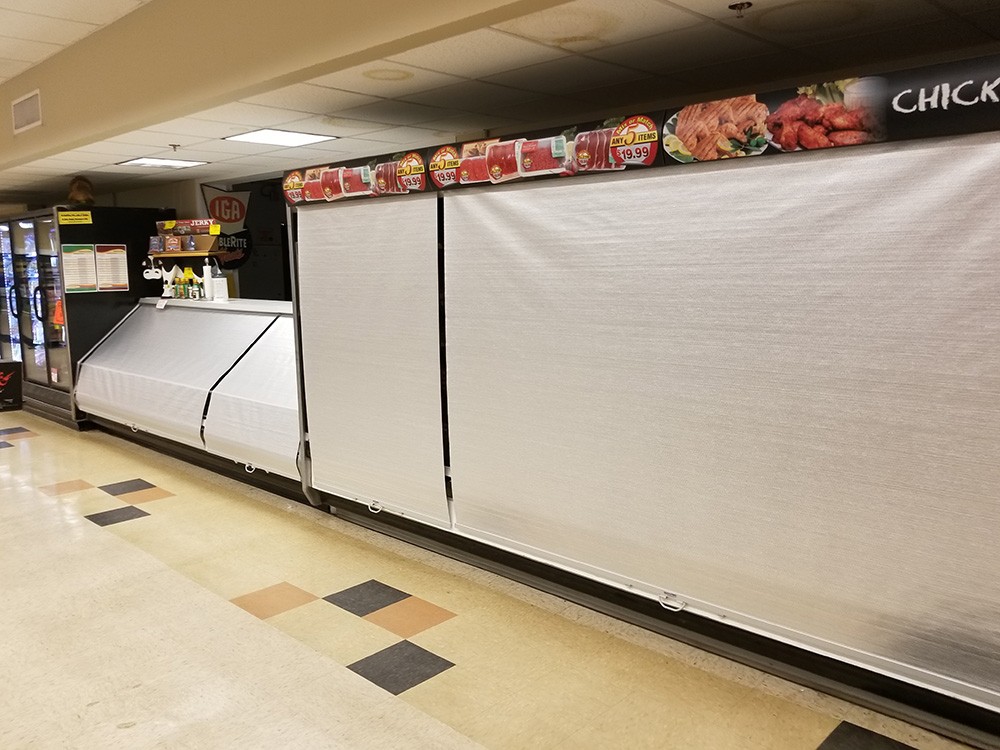
Fresh food merchandising is a balancing act between presentation and preservation. Supermarkets and grocery retailers need to display products in a way that appeals to customers, yet every minute those products sit in an open refrigerated case, they are exposed to conditions that accelerate spoilage. Temperature fluctuations, uncontrolled humidity, and air infiltration all combine to shorten shelf life, leading to unnecessary shrink, lost sales, and higher operating costs.
This is where Econofrost night covers play a critical role. More than a simple physical barrier, these woven aluminum thermal covers act as a scientifically designed tool for managing both temperature stability and humidity retention, two of the most important factors in slowing food spoilage.
Why Temperature Stability Matters for Shelf Life
Temperature is the single biggest driver of microbial growth and product degradation in fresh food displays. Even small variations can lead to measurable changes in shelf life:
- Meat and poultry: Higher case temperatures accelerate lipid oxidation, producing discoloration and off-flavors.
- Produce: Sensitive to warm air drafts, fruits and vegetables lose firmness and freshness faster.
- Dairy: Yogurt, cheese, and milk require tight temperature control to preserve nutrients and flavor.
When cases remain uncovered during closed hours, cold air escapes into the store environment. Compressors are forced to cycle more frequently to maintain set points, causing uneven cooling and allowing warmer air to infiltrate the case. This instability compromises product quality by exposing foods to thermal stress.
Night covers reduce this problem by trapping cold air inside the display, creating a thermal barrier that minimizes temperature swings. By keeping case interiors closer to discharge set points for hours after covers are deployed, spoilage processes are slowed dramatically.
The Hidden Role of Humidity in Spoilage
- While temperature is widely recognized, humidity control is just as important.
- Excessively dry air dehydrates produce, leading to wilting, shriveling, and weight loss.
- Excess moisture creates condensation, which supports microbial growth and surface spoilage.
Open cases, exposed to store HVAC systems and customer traffic, experience constant air exchange that disrupts humidity balance. This leads to faster moisture loss in leafy greens, fruits, and even packaged items.
Econofrost night covers act as a moisture stabilizer by reducing airflow exchange between the case and the store environment. The microclimate inside the covered case retains more balanced humidity, protecting delicate products from both dehydration and excess condensation.
Shelf-Life Extension in Action
When temperature and humidity are stabilized simultaneously, the results are visible:
- Produce remains crisp and retains chlorophyll longer.
- Meat retains natural color without accelerated browning.
- Dairy and deli items avoid sweating or surface drying.
This dual mechanism not only slows spoilage but also reduces shrink, lowers restocking frequency, and minimizes the need for markdowns. Retailers gain both financial savings and customer trust by ensuring shoppers consistently find fresh, appealing displays.
Why Covers Work Better Than Other Methods
Some supermarkets attempt to control spoilage strictly through refrigeration cycles or store climate management. However, these approaches have limitations:
- Increasing compressor run time raises energy costs and still fails to prevent infiltration from open aisles.
- Adjusting store humidity can create comfort issues for shoppers and staff.
- Glass doors, while effective at sealing, reduce product visibility and disrupt the open-case merchandising experience.
Night covers, by contrast, are a low-cost, passive solution. They don’t require major equipment overhauls, they preserve case visibility during operational hours, and they can be retrofitted across multiple case designs.
Long-Term Implications for Retailers
Shelf-life extension is not just about freshness—it’s about sustainability and profitability:
- Reduced shrink: Less spoiled product means less waste to dispose of and fewer lost sales.
- Lower operational costs: Stabilized cases reduce compressor cycling, saving energy.
- Improved food safety: Stable storage conditions minimize risks of microbial growth.
- Customer satisfaction: Shoppers trust stores that consistently deliver fresh, appealing food.
In the context of rising energy costs and sustainability goals, solutions that simultaneously extend shelf life and reduce waste provide measurable returns.
A Science-Backed Mechanism
The engineering behind Econofrost covers relies on three intertwined principles:
- Thermal Retention – Woven aluminum fabric reflects radiant heat away from the case while trapping cool air inside.
- Airflow Control – Covers act as a passive barrier, reducing infiltration from store HVAC currents.
- Humidity Preservation – With airflow slowed, internal case humidity stabilizes, creating a microclimate that protects perishables.
This integrated mechanism ensures food displays maintain both temperature integrity and moisture balance, two critical factors in the natural processes of oxidation, enzymatic activity, and microbial growth.
Conclusion
Freshness is the ultimate promise supermarkets make to their customers. Delivering on that promise requires more than refrigeration—it requires attention to how air, temperature, and humidity interact within every display case.
By deploying Econofrost night covers, retailers gain a powerful tool for shelf-life extension. Through simple yet effective thermal and humidity control, these covers slow spoilage, reduce waste, and improve overall operational efficiency.
The result is not only fresher food but also stronger margins, improved energy performance, and a more sustainable store operation.
Call to Action
Discover how Econofrost night covers can extend shelf life and protect your bottom line. Visit www.econofrost.com to explore proven solutions for supermarkets and retailers worldwide.