Why Heat Control Matters in Food Displays
Refrigerated cases are carefully engineered to maintain low and stable temperatures. However, lighting introduces a hidden heat load:
Localized hotspots can form directly under conventional LEDs or fluorescent lamps.
Even a 1–2°C rise in surface temperature accelerates microbial activity and lipid oxidation in meat, seafood, and dairy.
For produce, increased radiant heat speeds up wilting, discoloration, and nutrient degradation.
The challenge isn’t simply reducing total energy consumption—it’s about preventing uneven heating that undermines product integrity.
Standard LED Thermal Issues
Most standard LED systems are designed for general retail or architectural lighting. When adapted into refrigerated displays, they often struggle with:
- Poor thermal dissipation: High drive currents generate concentrated heat at the diode surface.
Without sufficient coatings or thermal barriers, this heat radiates toward products. - Spectral inefficiency: Lights optimized for brightness, not food safety, emit damaging blue-violet wavelengths that exacerbate oxidation while also contributing to surface warming.
- Case imbalance: Uneven temperature distribution forces compressors to cycle more frequently, increasing energy costs.
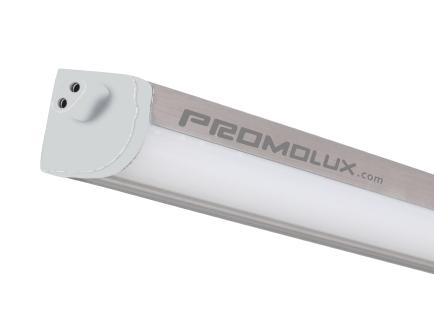
Promolux Multi-Coating Thermal Management
- Superior Heat Dissipation: Specialized coatings act as a buffer, dispersing thermal output more evenly across the LED surface.
This minimizes concentrated hotspots that can warm food surfaces directly beneath the lights. - Spectral Filtering + Thermal Stability: Coatings selectively filter harmful visible bands (500–630 nm) associated with photo-oxidation.
- Low Current Operation: Promolux COBs are engineered to operate below 50 mA, a significantly gentler current compared to standard LEDs.
This design reduces junction temperature inside the diode, extending both LED lifespan and food preservation.
Benefits for Perishable Foods
By combining precise spectrum control with multi-coating thermal barriers, Promolux LEDs protect a wide range of fresh categories:
- Meat & Poultry: Prevents surface heating that accelerates metmyoglobin formation and dull coloration.
- Seafood: Preserves natural pigments like astaxanthin in salmon and prevents early lipid rancidity.
- Dairy & Cheese: Avoids localized warming that can cause sweating, mold acceleration, or off-flavors.
- Produce & Leafy Greens: Maintains crispness by slowing chlorophyll breakdown and reducing transpiration losses.
Research Backing
Scientific findings reinforce the importance of both spectral and thermal management in display lighting:
- University of Zaragoza (Spain): Demonstrated that spectrum-balanced LEDs not only reduced oxidation but also maintained lower surface temperatures compared to conventional lighting.
- Texas A&M University, Department of Animal Science (USA): Confirmed that meats displayed under optimized LEDs experienced slower discoloration and lipid oxidation, with thermal load playing a key role in spoilage rates.
- Promolux Technical Archives: Internal testing on COB systems showed that multi-coating technology suppressed hotspot formation, maintaining more consistent case temperatures and improving shelf life across protein and produce categories.
Retailer Outcomes
Fewer markdowns: Products stay visually appealing longer, reducing rewraps.
Operational efficiency: Stable case temperatures reduce compressor strain and maintenance costs.
Improved merchandising: Food displays appear fresher, more vibrant, and more trustworthy to shoppers.
One North American retailer reported that after retrofitting their seafood cases with Promolux COB LEDs, visible hotspots disappeared and customer feedback on freshness improved noticeably.
Sustainability & ESG Perspective
Thermal management has a direct tie to sustainability:
- Reduced food waste: Preventing localized spoilage supports global waste reduction goals.
- Energy efficiency: Lower compressor cycling translates into energy savings.
- LED longevity: Cooler diode operation extends fixture lifespan, reducing replacement frequency and material waste.
In an industry where ESG reporting is increasingly important, integrating lighting technology that addresses both product quality and energy efficiency positions supermarkets as proactive sustainability leaders.
Implementation Considerations
Retailers planning to adopt Promolux COB with multi-coating thermal management should:
- Audit current case lighting for hotspot presence and uneven product temperature distribution.
- Prioritize sensitive categories like seafood, meat, and leafy greens for first installation.
- Integrate with existing refrigeration strategies, including night covers and airflow management, for maximum benefit.
Final Thoughts
In food retail, lighting is no longer a passive background element—it is an active player in product preservation. Poorly managed LEDs may save electricity but quietly shorten shelf life by creating hotspots and accelerating spoilage.
By dispersing heat, filtering harmful wavelengths, and operating at low current, they protect perishable products while enhancing visual appeal.
For supermarkets, this translates into lower shrink, reduced waste, improved energy efficiency, and stronger customer trust.
Learn more about spectrum-optimized, thermally stable lighting for food displays: www.promolux.com
References
- University of Zaragoza. Having Studies on thermal and spectral control in perishable food displays. Promolux Technical Archives.
- Texas A&M University, Department of Animal Science. Did Research on LED lighting, oxidation rates, and product shelf life.
- Promolux Internal COB Testing. Has Data on hotspot suppression and thermal management in refrigerated displays.